Airbnb’s 2026 Policy Changes: What Hosts Need to Know About House Rules, Rental Agreements, and Guest Communication
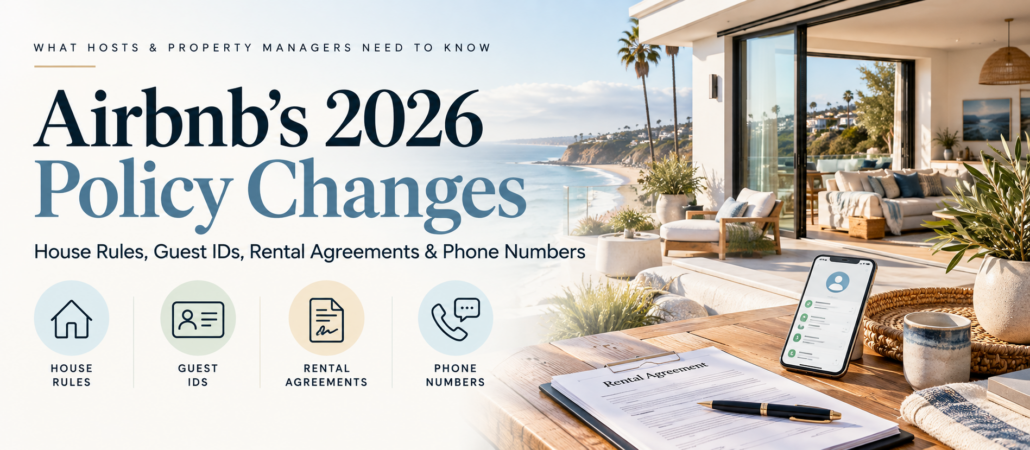
Airbnb is making several important policy changes this fall that will affect how vacation rental hosts and property managers communicate with guests, verify identities, use rental agreements, and establish house rules.
The changes roll out in two stages:
- October 26, 2026: Airbnb begins changing how guest phone numbers are shared with connected property management software.
- November 20, 2026: New rules take effect, limiting separate rental agreements, third-party ID verification, and other off-platform guest requirements.
For homeowners, most of this will happen behind the scenes. But for professional vacation rental managers, these changes may require significant updates to guest communication and reservation procedures.
Here’s what you need to know.
October 26: Airbnb Is Changing Guest Phone Number Access
Beginning the week of October 26, 2026, Airbnb is changing the phone number information it sends to connected property management systems, or PMS platforms.
For eligible reservations in the U.S. and Canada, Airbnb may provide a temporary phone number instead of the guest’s personal number. These temporary numbers can be used for calls and text messages and generally remain active until two days after checkout.
For some reservations, no guest phone number may be passed to the PMS at all.
This does not mean hosts can never access a guest’s phone number. Airbnb still provides contact information through its own platform for confirmed reservations. The biggest impact is on property managers who rely on phone numbers automatically flowing into outside systems.
Why does this matter?
Many professional vacation rental companies use guest phone numbers for:
- Automated pre-arrival texts
- Check-in instructions
- Door-code notifications
- Guest service messaging
- CRM automations
- Third-party guest registration
Those workflows may need to change.
Airbnb says its messaging platform should be the primary method of communicating with guests, and its temporary-number system is intended to provide additional privacy while still allowing calls and texts when needed.
November 20: Airbnb Is Limiting Separate Rental Agreements
A second, more significant update applies to Airbnb reservations booked on or after November 20, 2026.
Under Airbnb’s updated policy, hosts generally may no longer require guests to sign a separate vacation rental agreement unless the reservation qualifies for an exception.
Separate agreements may still be allowed when they are:
- Required by law
- Required by an HOA, building or community association
- Needed for an optional amenity, such as a separate golf cart rental
- Connected to a stay of 28 nights or longer
That is an important distinction for professional vacation rental managers.
Historically, many management companies have required every guest – whether they booked through Airbnb, Vrbo or directly – to sign the same rental agreement.
For standard short-term Airbnb reservations, that may no longer be permitted.
Airbnb Is Also Restricting Third-Party Guest ID Verification
Airbnb’s November update also limits when hosts can require guests to provide personal information or complete an outside guest ID verification process.
In general, hosts will no longer be able to require a guest to upload identification, register through another website or provide additional personal information simply because it is part of the management company’s standard process.
Exceptions may still apply when the information is required by law, an HOA, building security or another permitted Airbnb requirement.
Airbnb already requires booking guests to complete its own identity-verification process, although that verification happens within Airbnb rather than through the property manager. Airbnb also includes identity verification and reservation screening as part of its host protection tools.
For property managers currently using third-party guest screening or ID verification services, this is one of the most important parts of the new policy to review.
House Rules Are Becoming More Important
If Airbnb is limiting what can be included in a separate agreement, Airbnb house rules become much more important.
Airbnb introduced an updated house rules system on October 20, and its new house rules policy takes effect November 20, 2026.
Hosts can establish standard rules covering:
- Maximum overnight guests
- Quiet hours
- Events
- Pets
- Smoking and vaping
- Commercial photography
- Locking up at checkout
Hosts may also add reasonable requests for the property.
The important change is that these rules must be disclosed in the proper section of the Airbnb listing before the guest books. Airbnb says hosts cannot introduce new mandatory rules later through messages, signs at the property, or verbal instructions.
For professionally managed vacation rentals, this means important rules that previously lived primarily in a rental agreement may need to be incorporated directly into the Airbnb listing.
What About HOA and Local Requirements?
Airbnb’s policy does recognize an important exception for requirements imposed by law, an HOA, building security or a community association.
That matters for vacation rentals in San Diego County, where condominium communities and HOAs may have their own requirements for guest registration, parking, occupancy or access.
The key difference is that the requirement needs to come from the applicable law or community, not simply from the property manager’s preferred operating procedure.
Property owners and managers should make sure those requirements are documented and properly disclosed on Airbnb.
Airbnb Bookings vs. Direct Bookings
Another important point for homeowners: Airbnb’s policy applies to Airbnb reservations.
It does not mean separate vacation rental agreements or independent guest verification are disappearing from the vacation rental industry altogether.
A guest booking directly through a professional management company’s website may still be subject to the company’s rental agreement, guest verification requirements, and other booking procedures, subject to applicable law.
This makes the distinction between Airbnb bookings and direct bookings increasingly important.
It also highlights the value of a diversified vacation rental marketing strategy rather than relying entirely on one booking platform.
What Should Vacation Rental Managers Do Now?
Property managers should review their Airbnb procedures before the new policies take effect, particularly:
Guest communication: Make sure important arrival information does not depend entirely on receiving a guest’s personal phone number through your PMS.
Rental agreements: Determine which Airbnb reservations currently require an outside agreement and whether those agreements will still be permitted.
ID verification: Review any third-party guest screening or ID verification requirements.
House rules: Make sure occupancy, noise, pet, event and other important property rules are clearly entered in Airbnb’s designated house-rule fields.
HOA requirements: Document any community or building rules that may qualify for Airbnb’s exceptions.
Mid-term rentals: Remember that Airbnb specifically provides an exception for rental agreements associated with stays of 28 nights or longer.
What This Means for Vacation Rental Owners
For homeowners, Airbnb’s latest changes are a good example of why professional vacation rental management involves much more than putting a property online and accepting reservations.
Booking platforms continually change their policies, technology, and requirements. A procedure that works for a direct reservation or Vrbo booking may not be permitted for an Airbnb reservation.
At P.S. Platinum Vacation Rentals & Property Management, we monitor changes across Airbnb, Vrbo, and other major booking platforms and adjust our procedures as those policies evolve.
For vacation rental owners in Del Mar, Encinitas, Solana Beach, Cardiff, Carlsbad, Oceanside, La Jolla, Rancho Santa Fe, and throughout coastal San Diego County, staying ahead of those changes is an important part of protecting your property while maintaining a competitive and guest-friendly rental program.



